What do Facebook, Guinness Zero and solar panels all have in common?
They all took off because of people.
Not budgets, not mass media buys. People. Behaviours. Word of mouth. The invisible yet powerful stuff we often forget to account for in marketing plans.
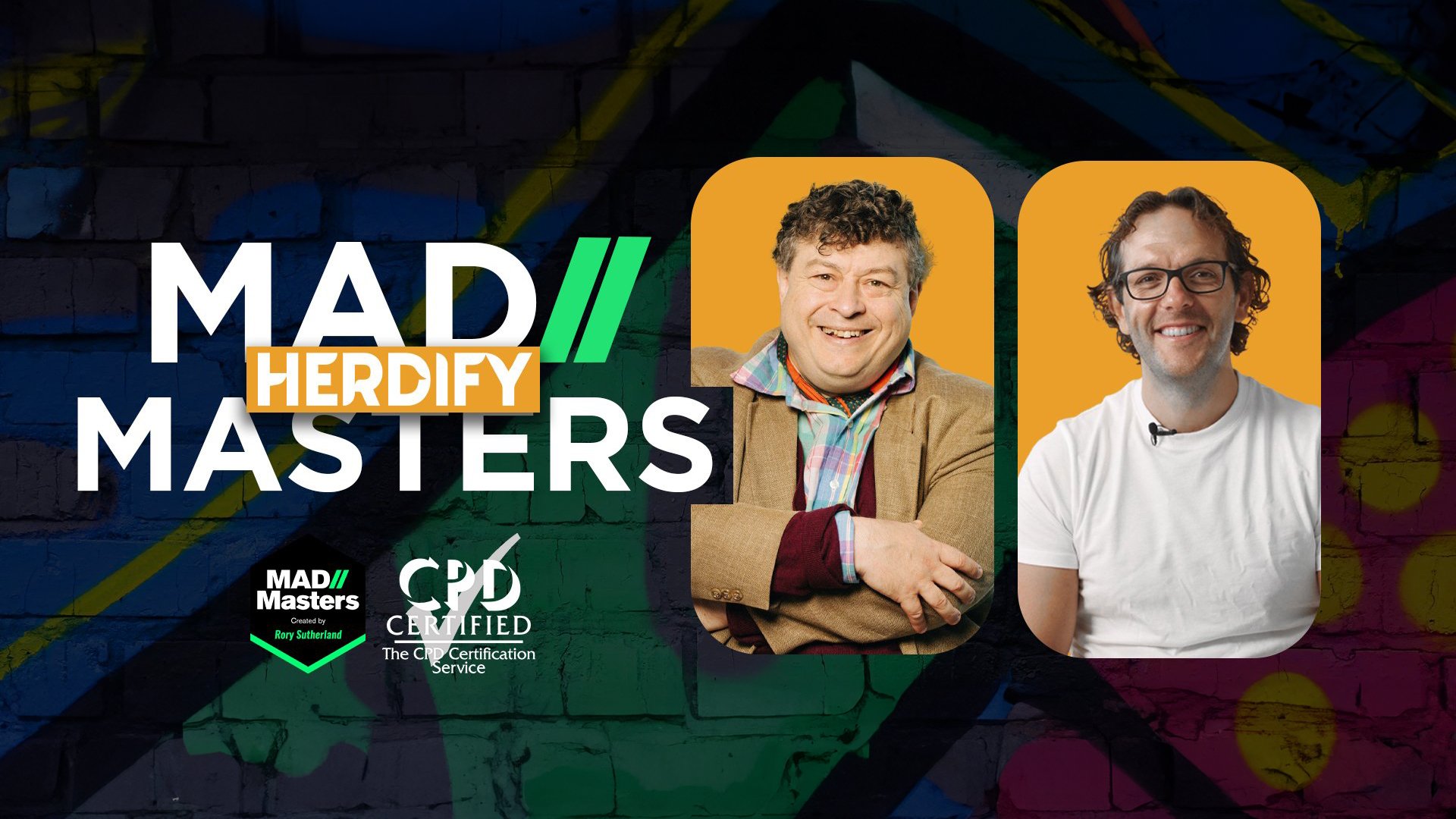
In this very special session hosted for MAD//Masters, Rory Sutherland and Herdify founder Tom Ridges go deep on challenger brands, behavioural science, and why scaling smart beats scaling fast.
If you're fighting bigger competitors with deeper pockets, this is for you. And if you're building something new and need it to spread fast without fizzling out, it's definitely for you.
https://youtu.be/_yBQvOItHZU
Key themes from the session:
1. Facebook grew by saying "no"
Mark Zuckerberg didn’t launch Facebook by targeting everyone. He focused on just one college; Harvard. Then another. Then another. Each launch triggered a local social network offline, and it spread through friend invites. It was a masterclass in controlled growth through word of mouth. And it worked.
Lesson: Stop thinking about how to reach everyone. Ask where not to advertise. Be deliberate. Be local. Let people do the heavy lifting.
2. Real life is a medium
Rory drops a simple but powerful line: "Real life is a medium too."
We’re not just influenced by ads. We’re influenced by what our friends drink at the pub. By what our neighbours install on their roofs. By how the room reacts at a comedy gig.
Behaviour spreads when it’s visible, social, and feels safe to follow. Challenger brands need to understand that visibility + normalisation = momentum.
3. You don’t need to be big to start big
From solar panels to Gusto boxes to collapsible cycle helmets, the pattern repeats: one person tries it, then another joins in, and then suddenly everyone around them is doing it too.
Tom talks about Ford customers driving two hours past closer dealerships just because that’s where their community still buys cars. That’s what happens when trust compounds. It sticks around.
4. Be famous in Reading
Most brands try to be everything everywhere, all at once. And they burn out. But as Rory says, you can be world-famous in one town first. If you’re smart about geography, you get more signal and less waste. It's how Facebook, Iron-Bru and even Dr Pepper did it.
Tom calls it the "street-by-street strategy". You don’t need a national campaign to start a national movement.
5. Don’t make your early adopters feel lonely
Rory's parting advice might be the most human: "If you're a challenger brand, make your early customers feel less lonely."
Because being first can feel risky. Weird. Embarrassing even. But if you give those early adopters proof they're not alone, through local marketing, community signals, or just great creative, you build the confidence they need to keep going (and keep buying).
Final thought:
This session isn’t just theory. It’s packed with real-world examples, insights into why people follow people, and how to build marketing plans that behave more like the humans you're trying to reach.
If you’re working in a scale-up, launching a new product, or tired of the CPM arms race, start here.