How are marketers really using AI? Dr Ed Barter, Co-founder and Head of Product at Herdify, broke it down in the Alliance of Independent Agencies’ webinar AI Without the Bullshit.
If you missed it, here’s the write-up, the tools list, and a few extras. You can also catch up on the full session via the link below.
A marketer’s guide to AI
If AI feels like it is raining down faster than you can refresh your inbox, you are not wrong. Recent forecasts suggest generative AI could reach the performance level of the top 25% of human workers on core business tasks by 2040, a shift that was once expected much later (McKinsey, 2023a). No wonder marketers feel both curious and slightly winded.
At the same time, there is a cold splash of reality. An MIT-backed study reports that 95% of organisations using generative AI see no measurable ROI, despite billions invested (TechRadar, 2025; Axios, 2025). The figures show both faces of AI adoption. On one side there is rapid acceleration. On the other, yawning gaps in business impact.
Sign up below to watch the full talk with Dr Ed Barter.
The marketer’s dilemma: fear and excitement
Marketers face genuine tension with AI.
The fears are clear:
- Falling behind. If 78% of organisations already use AI in at least one function, you risk lagging the competition (McKinsey, 2023b).
- Job insecurity. McKinsey estimates up to 30% of work hours could be automated by 2030, with 400–800 million workers displaced or needing to reskill (McKinsey, 2017).
- Failed investment. With 95% of generative AI pilots failing to show ROI, many teams fear wasted budgets (Axios, 2025).
The opportunities are equally strong:
- Productivity gains. Generative AI could add 0.1–0.6% to annual global productivity through 2040, rising to 0.5–3.4 percentage points when combined with automation (McKinsey, 2023a).
- Early adopter advantage. A McKinsey study found that 71% of companies using AI extensively expected revenue growth above 10% (Bughin et al., 2018).
- Augmentation not replacement. Forecasts suggest a 50% chance of high-level machine intelligence by 2040–2050, but most scenarios see augmentation rather than outright job loss (Grace et al., 2025).
AI in marketing is not just another channel or a passing tool. It is shaping the entire craft, from media planning to customer engagement.
The four applications that matter in marketing
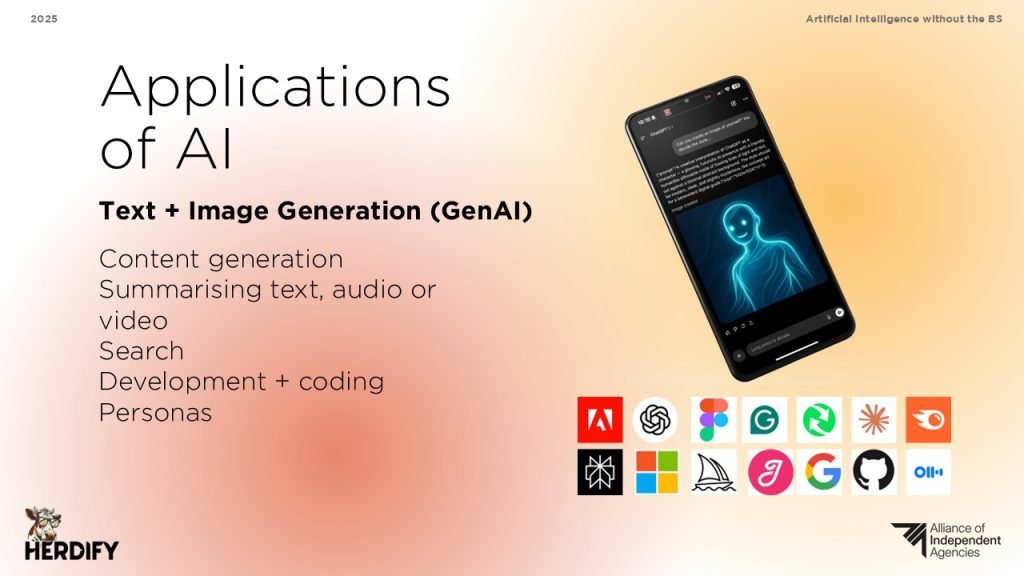
1) Text and image generation
Wins include:
- First drafts that eliminate the blank page
- Tidy-ups for tone and grammar
- Personalisation at scale beyond “Hi [Name]”
Limitations remain. Outputs are rarely production ready and brands still need human polish.
Tools for marketers:
- ChatGPT
- Claude
- Gemini (Google)
- Grok (xAI)
- Midjourney
- Figma / Figma Make
- Adobe Firefly
- Grammarly
- Perplexity AI
2) Insights and data analysis
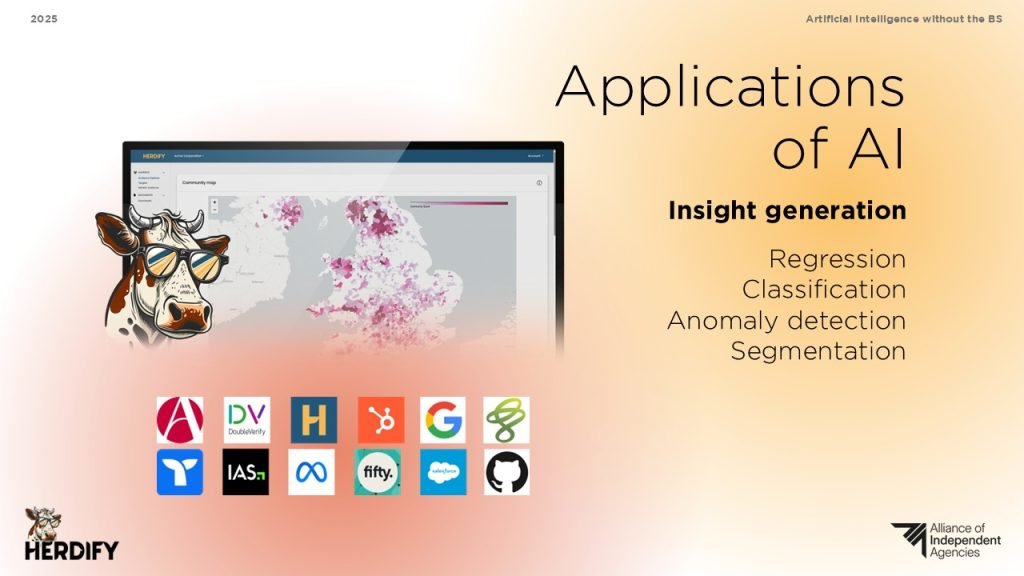
AI excels at regression, classification, anomaly detection and segmentation. The challenge is turning insights into actions. That is the gap Herdify bridges, by showing where word of mouth drives sales and then advising where media should go.
Tools for marketers:
- Robyn (Meta open-source MMM)
- CausalImpact (Google R package)
- GeoLift (Meta open-source geo experimentation)
- DoubleVerify
- Integral Ad Science (IAS)
- Fifty
- 3M VAS
- Adelaide
- Triple Whale
- Herdify
(plus CRM segmentation tools like Salesforce and HubSpot)
3) Optimisation and decision support
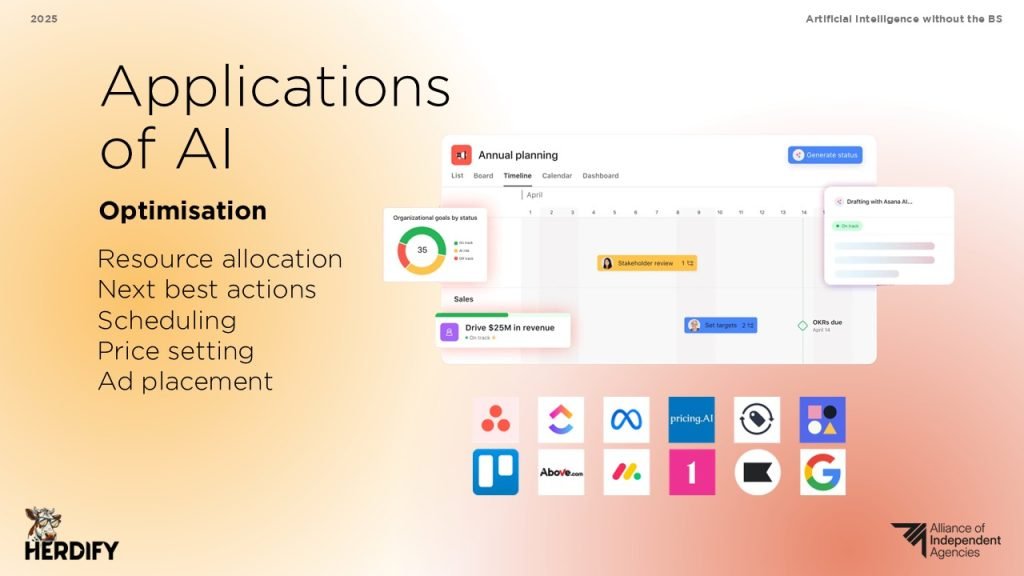
Most leadership calls are optimisation problems in disguise. Examples include:
- Allocating budget and people
- Choosing next best actions in campaigns
- Scheduling for productivity
- Pricing for margin and conversion
- Ad placement using systems such as Performance Max
The traps are clear. Optimise the wrong metric and you will chase vanity results. Optimise too literally and you will miss scale.
Tools for marketers:
4) Automation
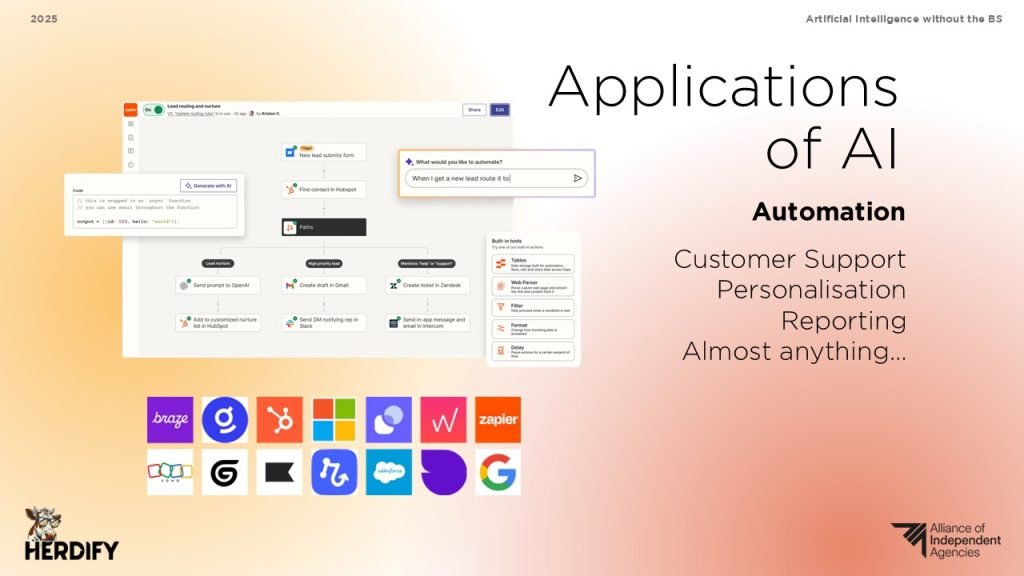
Tasks that involve moving data between systems can now be automated in minutes. Tools like Zapier or Gumloop allow marketers to describe the workflow in plain English and watch it build.
Tools for marketers:
- Sendbird
- Cuedesk
- Klaviyo
- Braze
- Google Merchant Center
- Microsoft Power Automate
- Glean
- Whatagraph
- Zapier
- Gumloop
- Relay
- Relevance AI
(plus CRM systems like Salesforce, HubSpot, or Zoho)
Agents: the next frontier
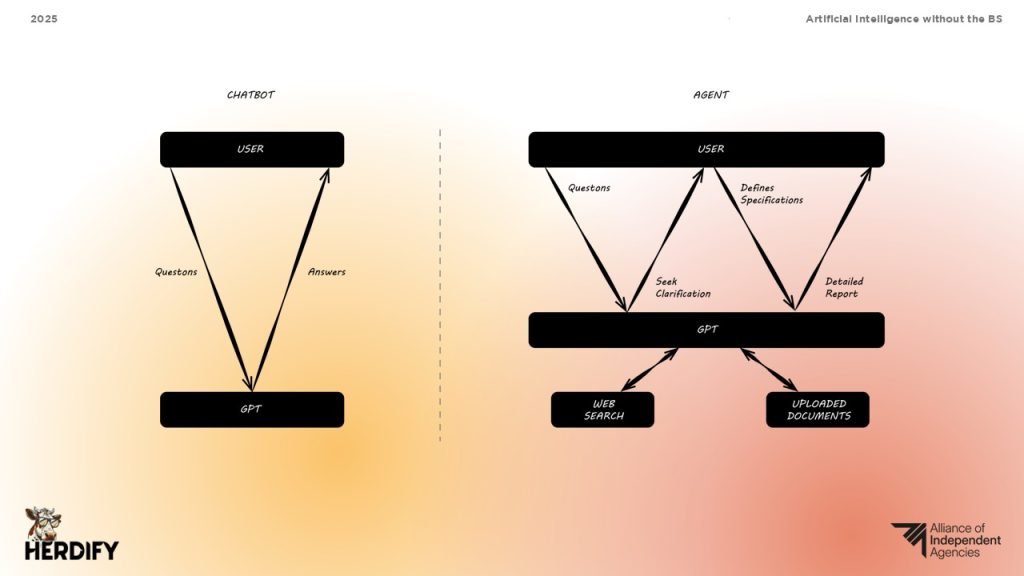
AI agents combine the four buckets. They can ask questions, use tools, fetch data and present answers in the format you request. They are promising, but the technology still lags the marketing hype. Use them where they reduce drudge, but keep human oversight for outcomes.
Closing the gap: how marketers should act now
AI is unlikely to replace marketers, but marketers who adopt AI well will outperform those who do not. The real risk is that a competitor using AI more effectively takes your customers.
Practical steps include:
- Experiment individually with tools that make your work faster or sharper
- Measure and share results to create business cases
- Stay focused on objectives before automating steps
FAQ: AI in Marketing
1. What are the best ways to start integrating AI into my marketing strategy?
Start with one clear goal, like automating email sends or personalising content. Test a single use case and scale from there. For instance, begin with email subject-line optimisation using tools like those recommended in our blog’s text generation section.
2. What risks should marketers consider with AI, and how do we mitigate them?
Risks include brand voice inconsistency, tone mismatch, and data misuse. To mitigate, create brand guidelines for AI outputs, verify content for accuracy and appropriateness, and keep humans in the loop for final review.
3. Can small marketing teams effectively leverage AI?
Yes. AI tools make content repurposing, segmentation, and campaign ideation scalable, even for lean teams. Start small (e.g., email optimisation or chatbots), test, and measure before expanding.
4. What ethical considerations should I keep in mind before deploying AI in marketing?
Be cautious about sensitive data, privacy, and biases in training data. Define clear policies around prompt usage, ensure transparency, and avoid prompting AI with confidential information.
5. What are marketers most curious about regarding AI search tools and emerging ad formats like Google’s AI Max for Search?
Marketers often ask: How does new AI Search (e.g. AI Max for Search) differ from Performance Max? These tools complement each other, AI Max optimises Search specifically, while Performance Max spans multiple channels. Together, they can boost conversions by up to 14%.
6. What is the difference between traditional SEO, Answer Engine Optimization (AEO), and Generative Engine Optimization (GEO)?
SEO focuses on ranking for keywords. AEO and GEO optimise content to be directly referenced by AI chatbots and answer engines. In an era where AI surfaces answers in chat, for example, Gemini or ChatGPT, this shift in optimisation strategy is crucial.
7. Is “AI washing” a real concern in marketing?
Yes. ‘AI washing’ refers to overstating or misrepresenting a product’s use of AI. It undermines trust and can mislead both clients and stakeholders. Stay transparent and honest about AI integration levels.
8. Are marketers truly seeing benefits from AI, or is it just hype?
A recent survey found that 82% of respondents said AI enhanced their marketing work, boosting confidence and efficiency. Daily users reported saving an average of 14 hours per week and over $5k in operational costs per month.

References
Axios (2018) Artificial intelligence early adopters see big advantage, says McKinsey. Available at: https://www.axios.com/2018/05/24/artificial-intelligence-early-adopters-advantage-mckinsey (Accessed: 10 September 2025).
Bughin, J., Seong, J., Manyika, J., Chui, M. and Joshi, R. (2018) Notes from the AI frontier: Insights from hundreds of use cases. McKinsey Global Institute. Available at: https://www.mckinsey.com/featured-insights/artificial-intelligence/notes-from-the-ai-frontier-insights-from-hundreds-of-use-cases (Accessed: 10 September 2025).
Grace, K., Salvatier, J., Dafoe, A., Zhang, B. and Evans, O. (2025) When will AI exceed human performance? Evidence from AI experts. arXiv preprint. Available at: https://arxiv.org/abs/2508.11681 (Accessed: 10 September 2025).
McKinsey (2017) Jobs lost, jobs gained: Workforce transitions in a time of automation. McKinsey Global Institute. Available at: https://www.mckinsey.com/featured-insights/future-of-work/jobs-lost-jobs-gained-what-the-future-of-work-will-mean-for-jobs-skills-and-wages (Accessed: 10 September 2025).
McKinsey (2023a) The economic potential of generative AI: The next productivity frontier. McKinsey Global Institute. Available at: https://www.mckinsey.com/capabilities/mckinsey-digital/our-insights/the-economic-potential-of-generative-ai-the-next-productivity-frontier (Accessed: 10 September 2025).
McKinsey (2023b) The state of AI in 2023: Generative AI’s breakout year. McKinsey & Company. Available at: https://www.mckinsey.com/capabilities/quantumblack/our-insights/the-state-of-ai (Accessed: 10 September 2025).
TechRadar (2025) US companies have invested billions in AI, but have little to show for it. Available at: https://www.techradar.com/pro/american-companies-have-invested-billions-in-ai-initiatives-but-have-basically-nothing-to-show-for-it (Accessed: 10 September 2025).
.png)