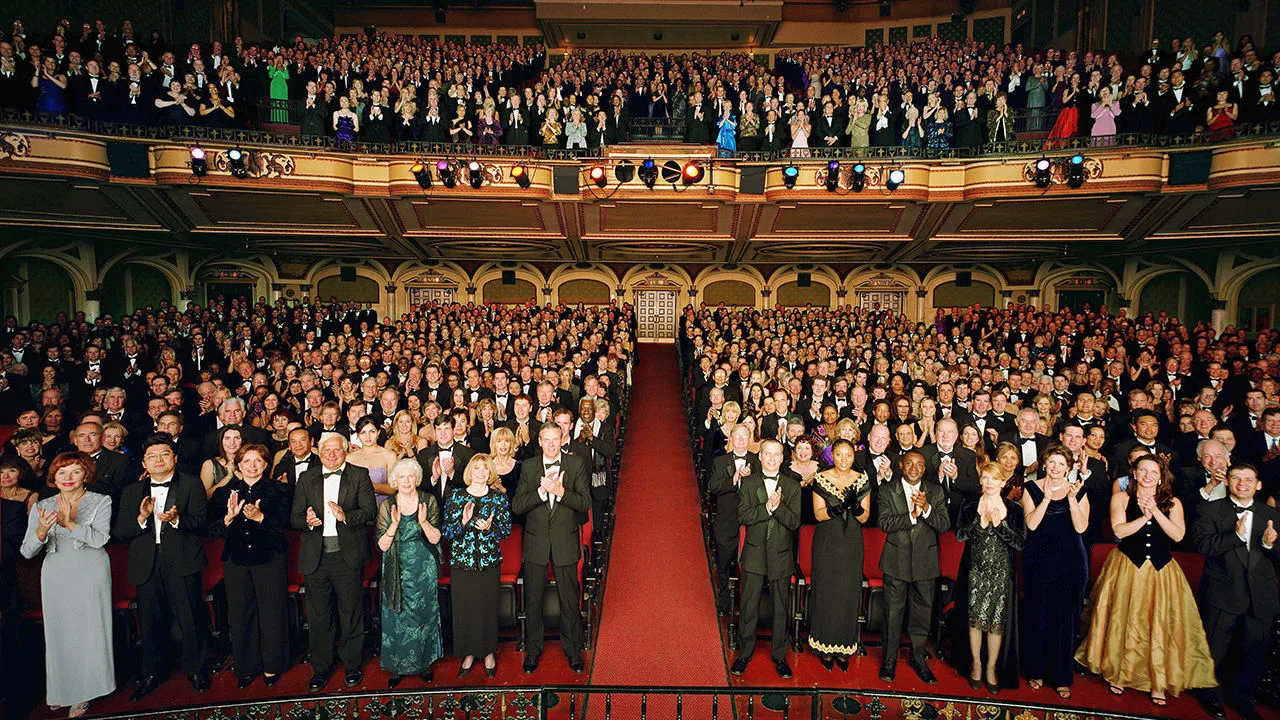
What do standing ovations and effective marketing have in common?
When does a standing ovation actually happen? On the surface, it feels simple: the performance is brilliant, the crowd is impressed, and they leap to their feet in appreciation.
But hang on, there’s more going on here than just individual opinion.
Think about it. A standing ovation involves the whole audience. Not everyone is making a fully independent decision. People don’t each run a mental checklist and decide, yes, this deserves a stand. They look around. They notice who’s standing. And often, they copy.
That’s influence. And that’s exactly what makes this so interesting for marketers.
From one clap to a cascade
When you look closely, a standing ovation is a cascade. A few people rise to their feet. Others see this and join in. Then more. And more. Until the whole room is up.
It’s not really about rational thought and judgement. It’s about what you see the people around you doing. And that’s where it starts to get interesting for marketers.
Miller and Page’s standing ovation model
Two mathematicians, Scott Page and John Miller, have spent more than an ordinary amount of time thinking about standing ovations (safe to say they are experts). They created a model that breaks down how people decide to stand up based on what they see around them.
In one of their simpler (but surprisingly powerful) models, they propose that each audience member is only influenced by the people they can see a few rows in front of themIf enough of those people are standing, they’ll stand too.
You can think of this like advertising. Seeing a single ad doesn’t usually make someone buy. But seeing them again… and again… especially when others are engaging with it too, that’s when action happens.
So, in this model, the cascade starts when a few people stand up. Others see them, and stand too. Now the group of visible standers gets bigger, which tips the next group, and so on. The standing spreads through the crowd like a ripple.
Here’s the twist: where someoneis in the crowd matters. People near the front can be seen by more people behind them, so they have more power to trigger the cascade. Front-row influence, if you like.
So… we tested it
At Nudgestock, the biggest behavioural science festival going, we decided to put this to the test.
We planted people in the audience. Gave them one job: stand up at the end of the talk, no matter what.
We gave them prime front-row seats. Visibility was key. The science said this should trigger a cascade. A wave of applause. A room on its feet.
Only… it didn’t.
No cascade. No domino effect. Not even a polite ripple.
Our planted standers stood, and stood alone.
Which begs the question…
Why didn’t it work?
Here’s one theory. Marketers aren’t normal people.
At least not in a theatre audience.
They’re trained to spot the plant. To resist the nudge. To think independently, even when the whole point is not to.
It’s a lovely irony, really. The people who talk the most about behavioural science are often the hardest to nudge.
But that failure says something important.
Influence isn’t guaranteed. Cascades don’t just happen because you want them to. Even in the perfect conditions, front-row seats, planted behaviour, visibility, people might still not follow.
Unless they’re part of the right network. Unless they trust the people around them. Unless the context makes sense.
And that’s where it gets interesting for marketing
Because buying behaviour works just like ovations, but only when it happens in the right setting.
According to Nielsen, 92% of people trust a recommendation from a friend more than any ad. That’s not just about messaging. It’s about who the message is coming from.
And it’s why cascades of behaviour, word of mouth, referrals, social influence, only start when the right people see the right thing at the right time.
You can have the perfect message. But if it’s not showing up where the network effect kicks in, nothing happens.
Just like our failed ovation.
That’s where Herdify comes in
Herdify uses behavioural science to spot the communities where influence is already happening and where your marketing can tip the scales. We show you where to put your media to trigger cascades of buying behaviour.
It’s not just targeting. It’s targeting where behaviour spreads.
Want to see how this works for your brand?
Further reading
The Science of Standing Ovations (INFO 2040/CS 2850/Econ 2040/SOC 2090 Blog)
The Standing Ovation Model – Why Model & Segregation/Peer Effects (Coursera)
.png)